
Overview
Ashok Leyland's Cab Panel Press Shop (CPPS) is a high-volume automotive manufacturing facility where every minute of downtime directly impacts production output. During my internship, I worked with production, maintenance, utilities, and quality teams to study real industrial challenges and develop Industry 4.0-driven solutions focused on two ambitious goals: Zero Downtime and Zero Defect Manufacturing.
Rather than working on a single project, I investigated multiple operational challenges across predictive maintenance, hydraulic systems, cooling systems, condition monitoring, machine vision, and quality inspection. The objective was simple in theory but difficult in practice:
"How do you detect failures before they happen and defects before they leave the production line?"
That became the foundation of my internship.
The Problems Worth Solving
Manufacturing equipment generates enormous amounts of information every second—vibration signatures, motor currents, oil temperatures, pressure variations, cooling system behavior, and production quality data. Most of this information is ignored until a breakdown occurs.
Across the plant, I identified several critical industrial challenges:
- Servo Motor & Gearbox Failures Unexpected mechanical wear and misalignment in robotic systems.
- Hydraulic Clutch Wear Friction-related clutch degradation causing unexpected press line stoppages.
- Cooling Water Scaling Mineral buildup in heat exchangers reducing heat transfer efficiency.
- Hydraulic Oil Health Contamination, viscosity changes, and moisture ingress causing valve degradation.
- Centralized Analytics Lack of real-time dashboards for predictive maintenance metrics.
- Body Panel Inspection Subjective, manual quality control checks for automotive body panels.
Engineering Solutions Developed
To address these challenges, I designed six Industry 4.0-based solution frameworks:
- 1. Servo Motor & Gearbox Predictive Maintenance System Developed a condition-monitoring architecture using vibration analysis and motor current signature analysis (MCSA) to detect bearing wear, gearbox degradation, shaft misalignment, coupling looseness, overload conditions, and early-stage mechanical faults. The system combined time-domain features such as RMS, Crest Factor, and Kurtosis with FFT-based frequency analysis to identify fault signatures before catastrophic failure could occur.
- 2. Cooling Water Scaling Monitoring System Designed a predictive maintenance framework using differential pressure monitoring across heat exchangers to detect mineral scaling buildup within cooling circuits. The system continuously tracks pressure drop trends and predicts future scaling severity, enabling condition-based cleaning instead of fixed maintenance schedules.
- 3. Hydraulic Press Clutch Wear Monitoring Investigated the relationship between hydraulic oil temperature behavior and clutch degradation. The proposed methodology uses thermal trend analysis to provide early warning indicators of clutch wear and friction-related failures before production is affected.
- 4. Hydraulic Oil Health Monitoring System Developed a framework for monitoring contamination levels, viscosity changes, moisture ingress, and oil degradation within hydraulic systems. The goal was to move from reactive oil replacement to condition-based maintenance using continuous monitoring.
- 5. Smart Maintenance Analytics Dashboard Designed real-time maintenance dashboards capable of visualizing machine health, alarm conditions, maintenance KPIs, fault trends, and predictive insights. The dashboard transforms raw sensor data into actionable maintenance decisions for engineers and plant managers.
- 6. Automated Quality Inspection Using 3D Vision & AI Proposed a next-generation inline inspection system for automotive body panels using 3D vision, point-cloud processing, CAD comparison, deviation analysis, and deep-learning-based anomaly detection. The objective was to replace subjective manual inspection with a scalable, data-driven quality assurance system capable of supporting Zero Defect Manufacturing.
Internship Artifacts & Certification
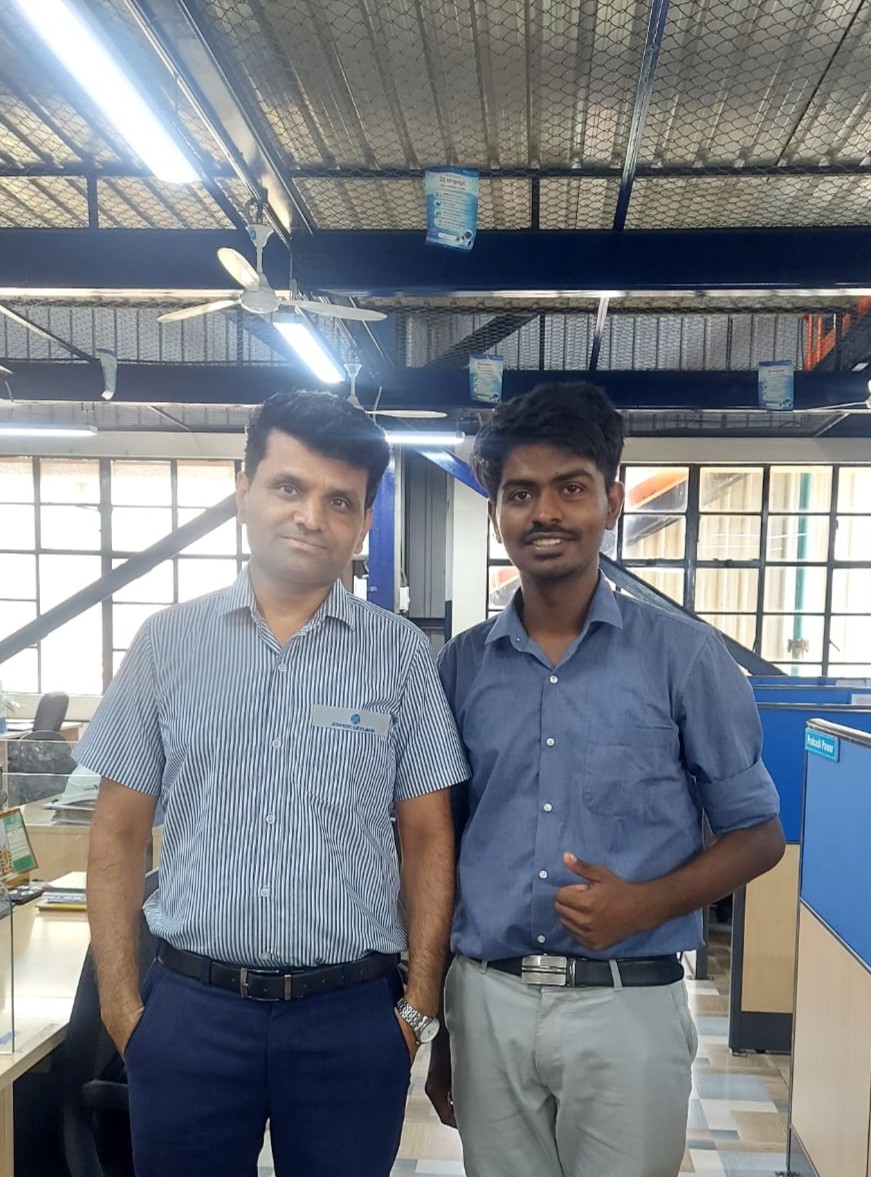
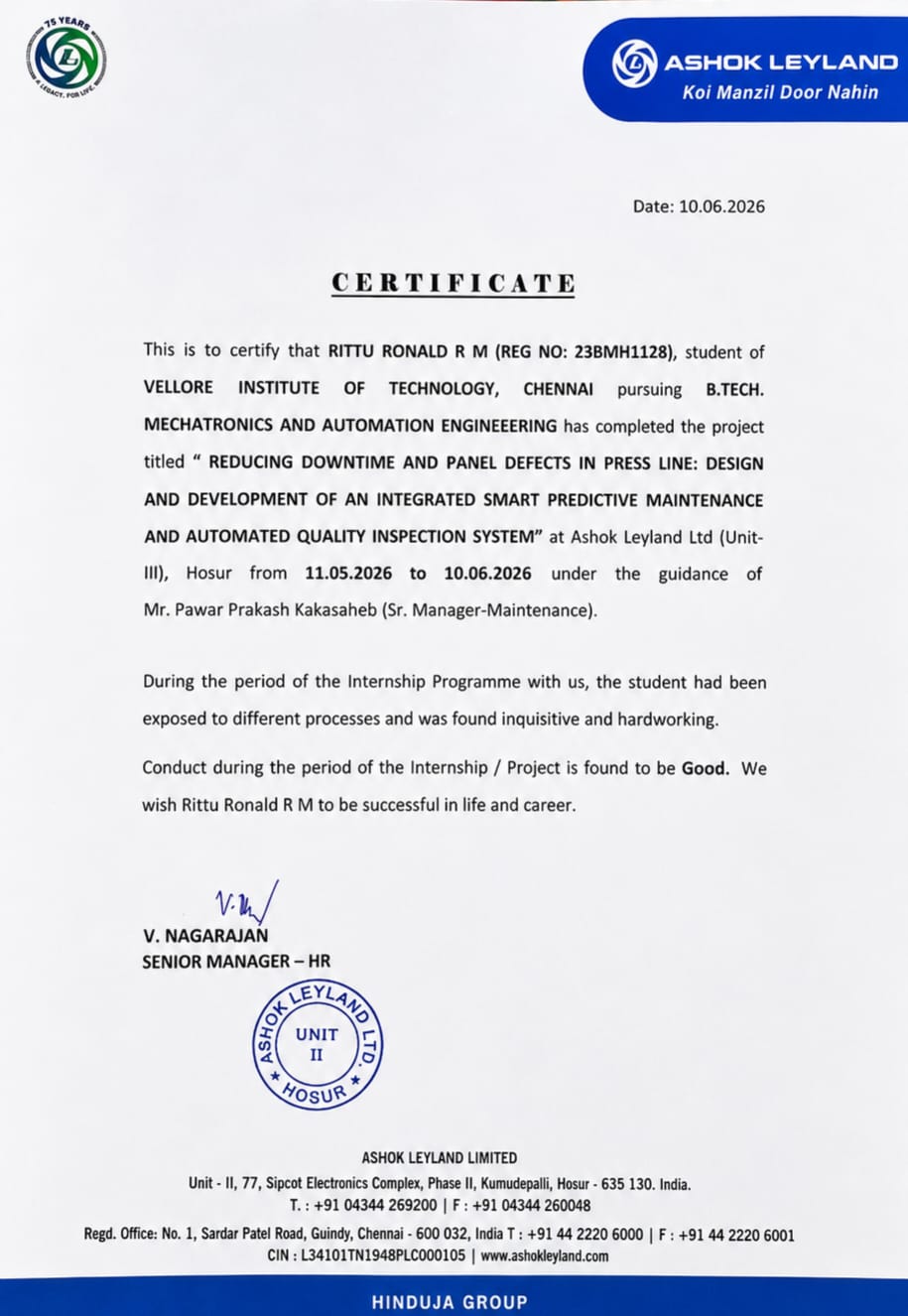
Official certification and visual documentation from my project internship at Ashok Leyland:
What I Learned
Ashok Leyland showed me how engineering decisions are made when production, reliability, maintenance, and quality all compete for attention.
In academics, predictive maintenance is often presented as algorithms and sensors. In industry, it becomes a business problem. Every avoided breakdown saves production hours. Every detected defect prevents rework. Every maintenance decision affects operational efficiency.
This internship taught me to bridge the gap between engineering theory and industrial reality. I learned how predictive maintenance systems are architected, how machine condition monitoring is implemented, how quality inspection can be automated using computer vision, and how Industry 4.0 technologies create measurable value inside a manufacturing plant.
Most importantly, I learned that smart manufacturing is not about adding more sensors. It is about turning industrial data into decisions before problems become downtime.
The future of manufacturing belongs to factories that can predict, learn, and adapt. This internship gave me a front-row seat to that transformation.