Overview
IPRC Mahendragiri is where rocket engines go before they're trusted with a mission. It is the facility where propulsion systems are assembled, integrated, and fire-tested - weeks before the same engines power India's launch vehicles into orbit. Training here meant stepping into the most critical node of India's space program, where the margin for error is essentially zero.
Rocket Engine Assembly & Integration
Studied the complete assembly and integration workflow for three of ISRO's most critical engines:
- Vikas Engine Used in the 2nd and 4th stages of PSLV and the 2nd stage of GSLV. Understood its turbopump architecture, gas generator cycle, thrust chamber assembly, and auxiliary systems.
- Cryo Engine Used in the 3rd stage of PSLV. Explored its cryogenic propellant handling requirements and the precision demanded during integration.
- Semi-Cryo Engine The next-generation replacement for GSLV's 2nd stage. Studied its advanced architecture and how it improves upon existing systems.
Beyond individual engines, I studied how these are integrated into complete launch vehicle stages - GS2, CUS (Cryo Upper Stage), and C25 - understanding how individual components scale into mission-ready systems.
PLC Controls & Instrumentation
Analyzed the full control and instrumentation stack used in ISRO's engine test facilities:
- PLC Automation Studied MIMIC monitoring panels and PXI data acquisition systems, understanding how automated sequencing logic governs engine test operations from ignition to shutdown.
- Measurement Systems Worked through pressure, temperature, flow, and level measurement systems used in live test environments - understanding how each sensor feeds real-time data into the control loop.
- Command Systems Analyzed how E/P valves and control valves interface with propellant management systems during hot-fire testing.
Test Facilities
Gained direct exposure to five of ISRO's major test stands — each designed for a specific phase of propulsion validation:
| Facility | Purpose / Validation Phase |
|---|---|
| PTS Principal Test Stand | Vikas engine static fire testing |
| TCT Thrust Chamber Test Facility | Thrust chamber performance validation |
| SIET Semi-Cryo Integrated Engine Test | Semi-cryogenic engine testing |
| MET Main Engine Test Facility | Full engine acceptance testing |
| ATS Altitude Test Stand | High-altitude simulation for upper stage engines |
Aerospace Fabrication & Manufacturing
Observed the precision manufacturing processes that feed directly into engine assembly:
CNC Machining
- Lathe and milling operations for aerospace-grade components.
- Micron-level tolerances for mating engine parts.
Orbital TIG Welding
- Automated orbital welding for high-integrity engine piping.
- Ensures flawless, consistent weld quality across joint profiles.
Autogenous Welding: Fusion welding techniques used for critical propellant-carrying components where filler material contamination is unacceptable.
Traineeship Artifacts & Certification
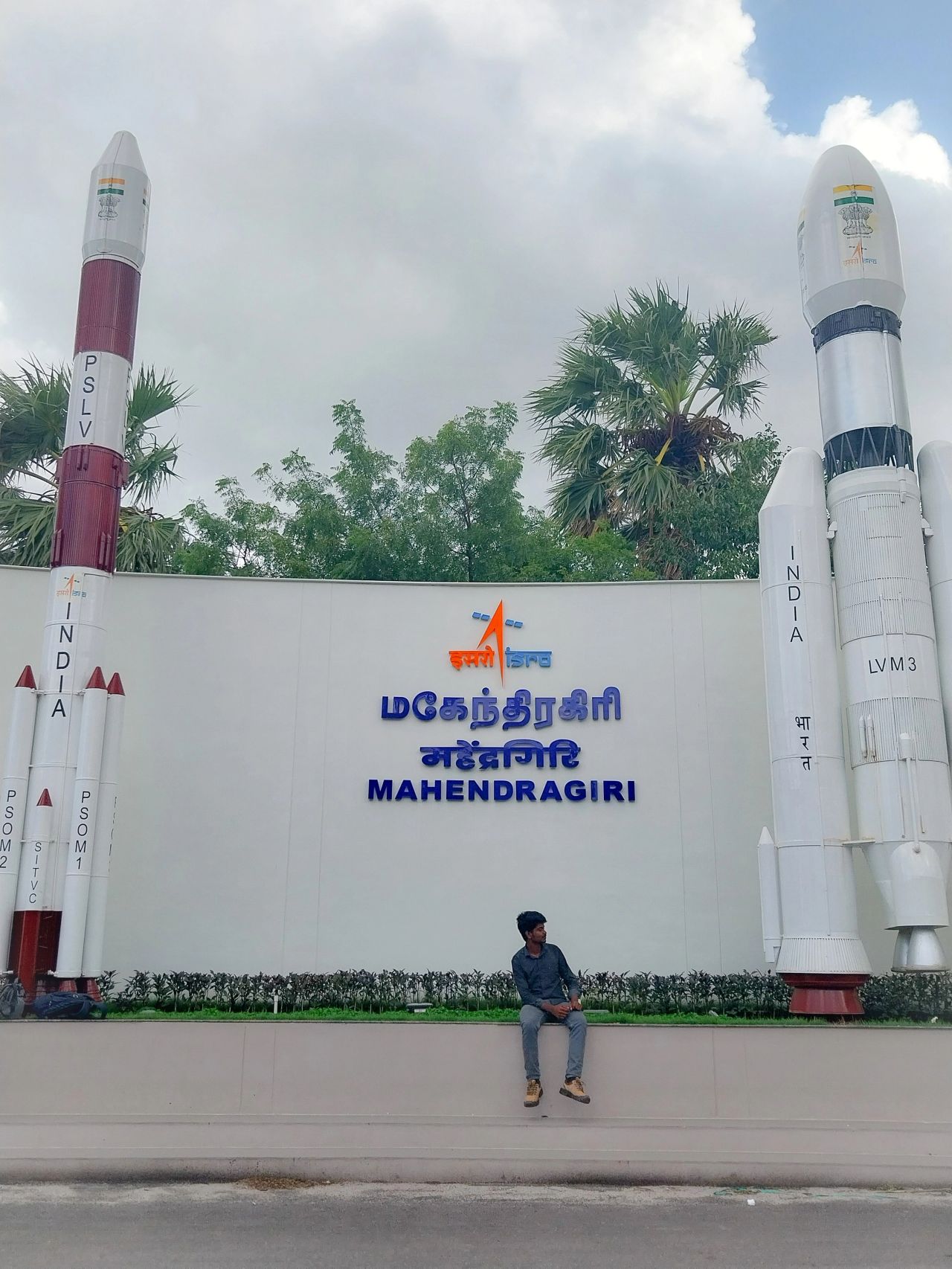
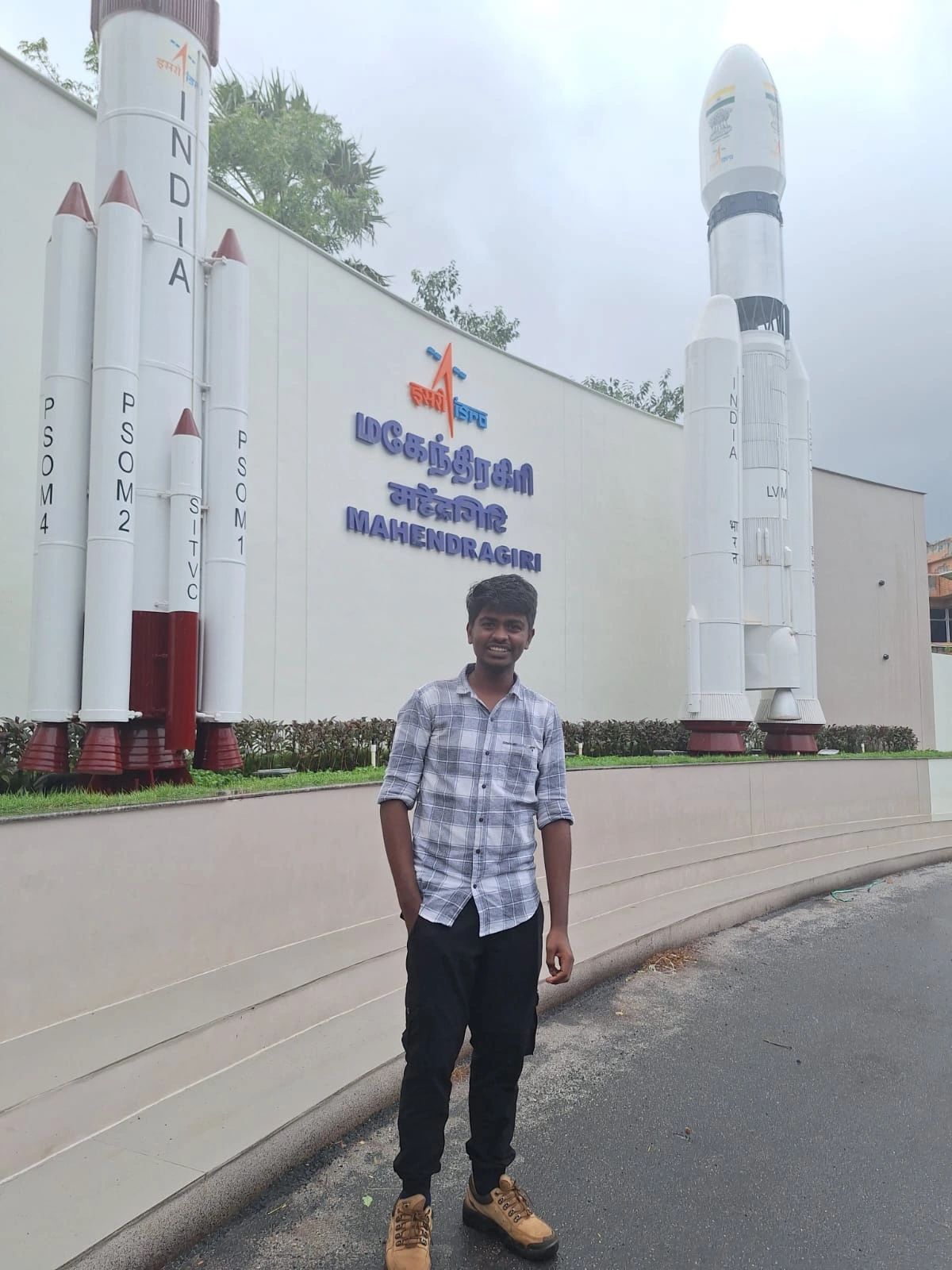
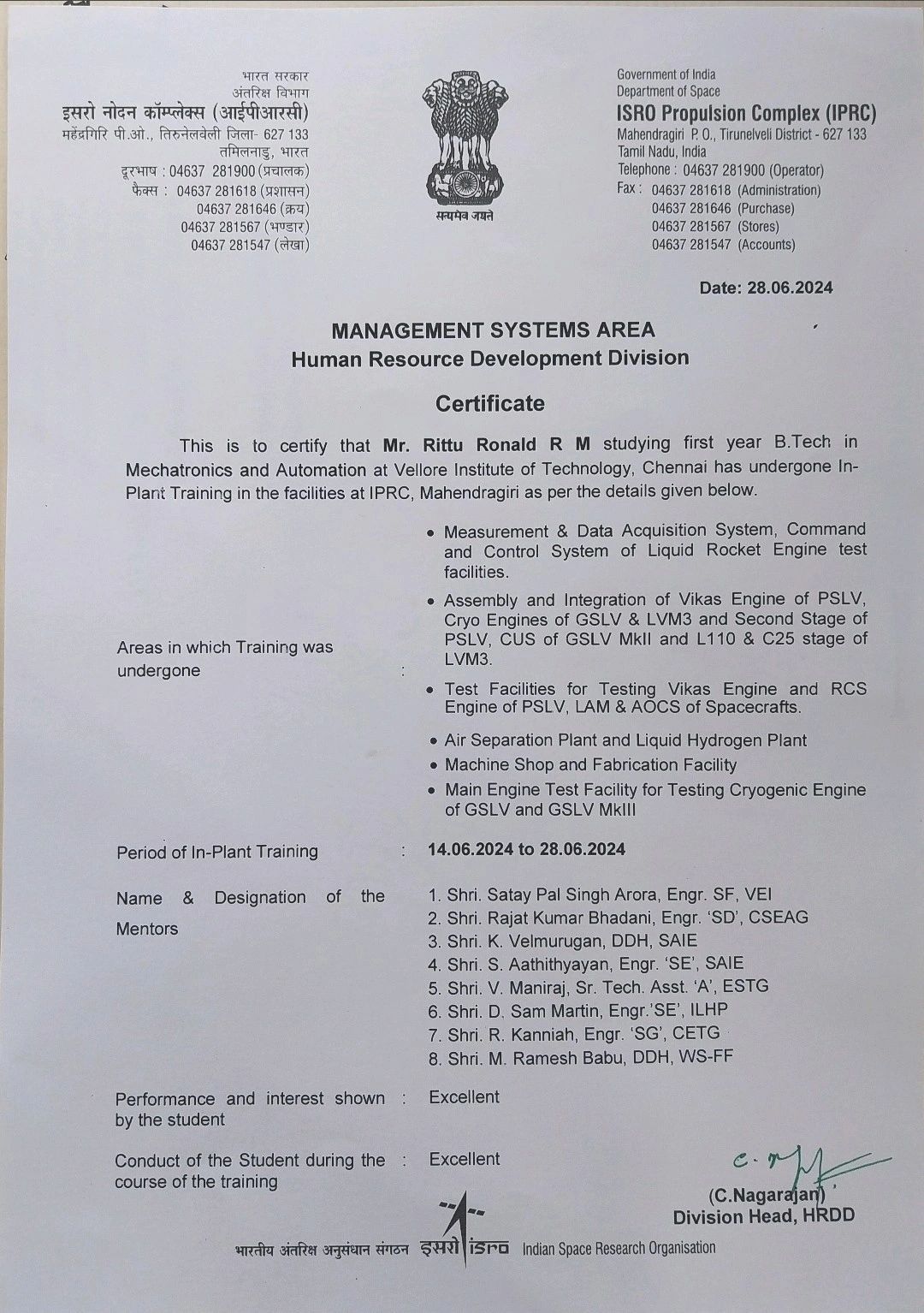
Official verification and visual documentation from the ISRO Propulsion Complex (IPRC) Mahendragiri:
What I Took Away
ISRO taught me that precision isn't a preference in aerospace - it's a survival requirement. Every valve position, every sensor reading, every weld is directly connected to whether a rocket succeeds or fails. There is no room for "close enough."
Seeing how PLC automation, instrumentation, mechanical assembly, and rigorous testing converge at IPRC fundamentally shaped the way I think about engineering reliability. It is the standard I now hold every system I build to - and the reason predictive maintenance became one of my deepest interests. Because at ISRO, I saw firsthand what happens when a system fails without warning.