Overview
Rane Madras Limited manufactures automotive steering racks at scale. Heat treatment - essential for surface hardness - introduces bends ranging from a few microns to several millimetres along each rack's length. RML's MAE automated bend correction machine was the answer, but years of shop-floor use had left it unreliable. Our team's job was to understand why it was failing, design fixes, and propose what a digitalized next-generation system should look like.
The project ran two tracks simultaneously: a brownfield effort to restore and upgrade the existing machine, and a greenfield exploration of better sensing technologies to replace it.
The Problem Worth Solving
Steering racks emerge from induction hardening with unpredictable bends - deviations from the symmetrical axis that current correction systems reduce but cannot consistently eliminate. Every uncorrected micron at the wrong point can fail a customer quality gate. The existing MAE machine had the right architecture but had degraded to the point where its measurements were no longer repeatable.
Force Modelling & ANSYS Validation
Beam-deflection formulas were derived from Euler-Bernoulli theory for a simply supported rod under an off-centre point load. Corrective forces were computed and cross-verified in ANSYS Static Structural - confirming the linear force-deflection relationship while revealing where the theoretical model breaks down for larger deflections.
Perception System Alternatives
The existing Heidenhain MT12 LVDT setup used a 2.5:1 mechanical lever arrangement - badly corroded and introducing measurement play. Three replacements were designed and evaluated:
- LASER Triangulation Non-contact single-pass scan of the full rack length; hardware and algorithm both specified.
- Computer Vision Pipeline MATLAB/Simulink image processor using Canny edge detection and polynomial regression to locate maximum deviation; tested on simulated bent-rod images.
- Halo 4-LVDT Array Four sensors at 90° intervals on a sliding ring, computing a 2D displacement vector (magnitude + direction) at every cross-section without any lever mechanism.
Machine Reconditioning & IoT
A full mechanical and electrical audit of the MAE machine was conducted. The lever linkage was severely corroded; the conical clamp allowed rod slippage during rotation. A solenoid drop-type positioning system was designed - direct 1:1 LVDT contact with the rack, sensor retracting into a recess during the correction punch to avoid damage.
A zero-base master gage rod was also designed for fabrication to give sensor calibration a true reference. For digitalization, an IoT-SCADA framework was proposed to connect the PLC to a cloud database for remote monitoring and cycle-record access.
Internship Artifacts & Certification
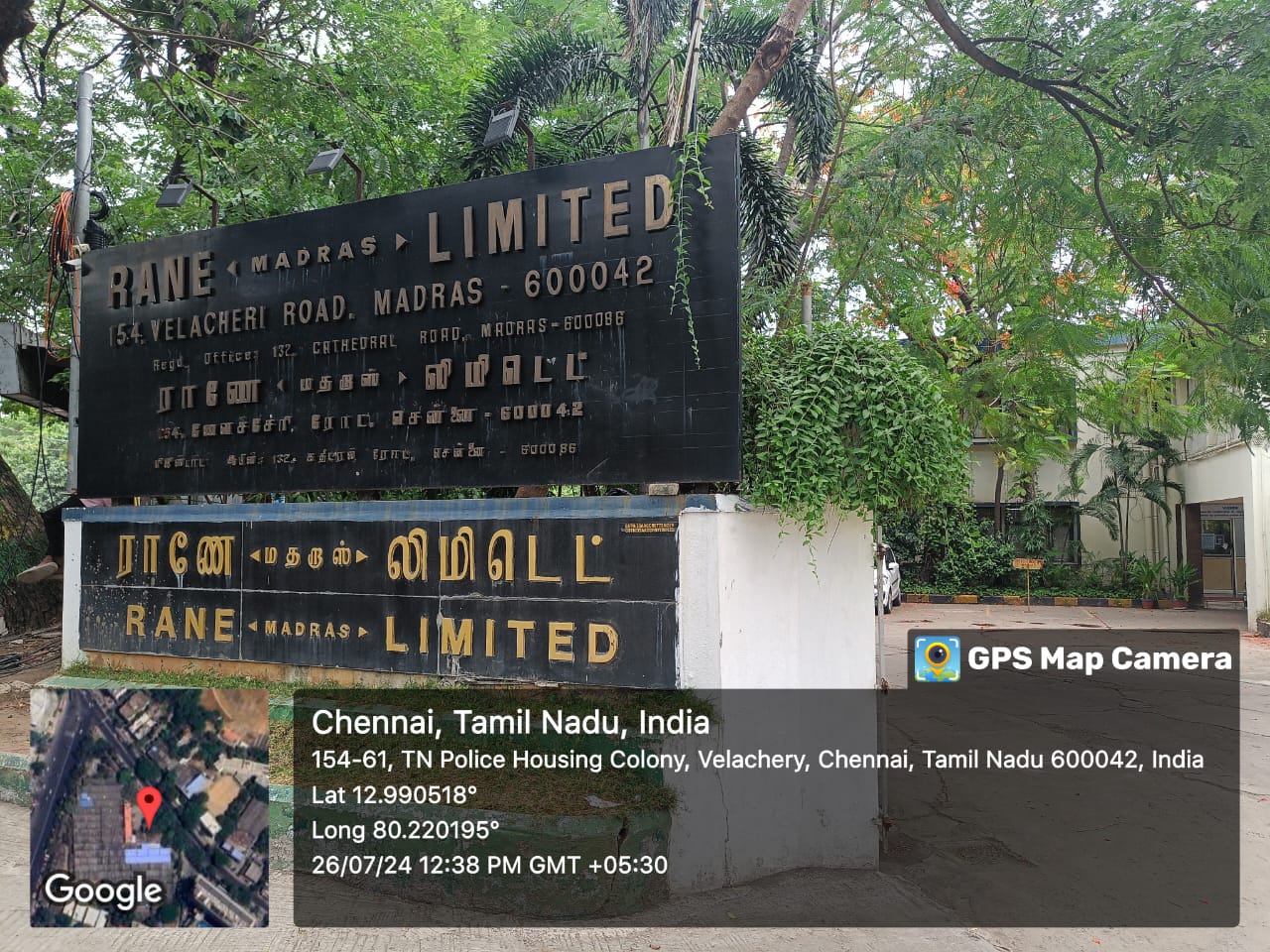
Official project documentation and training certification from my mechatronics internship at Rane Madras Limited:
Rane Certificate.pdf
Click to open PDF Certificate
What I Took Away
Project Rane closed the gap between coursework models and live industrial machines. The ANSYS cross-check showed exactly where theoretical assumptions hold and where they quietly break down.
The machine teardown showed that even state-of-the-art equipment degrades into unreliability without the right maintenance and digitalization scaffolding around it - and that identifying those gaps is as valuable as building the fix.