Project Overview
Vehicle crashboxes are designed for one job - absorbing impact energy as efficiently as possible to protect occupants during a collision. The conventional approach works, but nature has been solving the same energy-absorption problem for far longer. This project asked whether biological structures could do it better.
The Problem
Standard crashbox geometries are functional but not optimized for maximum energy absorption per unit of material. Biological structures - from bone lattices to beetle shells - have evolved highly efficient load-bearing and energy-dissipating forms over millions of years. The challenge was to identify the right biological analogue, extract the underlying structural principle, and translate it into a crashbox design that could be validated through simulation.
What We Built
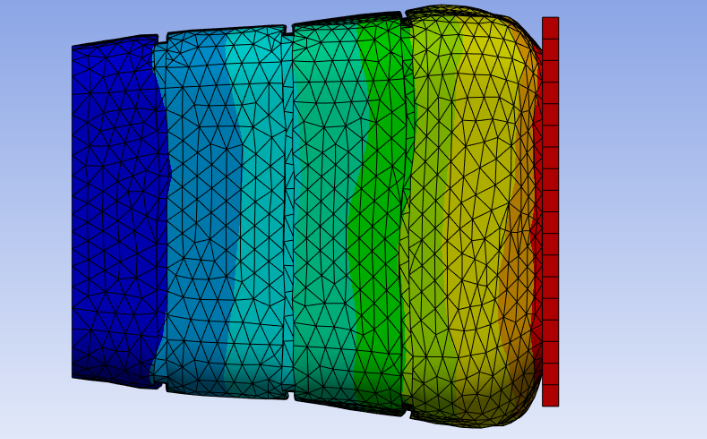
The team analyzed existing crashbox designs and selected a bio-inspired geometry based on natural energy-absorption structures. The new design was modeled in Fusion 360, capturing the geometric features that give the biological reference its mechanical advantages. Structural impact simulations were then run in Ansys to quantify how the redesigned crashbox performed under collision loading - measuring energy absorption, deformation behavior, and peak force transmission compared to the baseline.
What Made It Work
The value of the bio-inspired approach came down to geometry - specifically how the structural form distributes and dissipates impact energy across a greater volume of material rather than concentrating deformation. The Ansys simulation environment allowed the team to iterate on the geometry and directly compare performance metrics, giving a clear picture of where the bio-inspired design improved on convention and where further refinement was needed.
What It Demonstrated
This project developed practical skills in CAD modelling, FEA simulation, and design-for-performance thinking - and demonstrated how cross-disciplinary thinking, drawing on biology to solve an engineering problem, can open up design directions that purely conventional approaches would miss.
FEA Impact Simulation Logs
Simulated collision load outputs indicate high energy dissipation characteristics at maximum deformation vectors:
[LOAD CASE] Collision velocity: 15.0 m/s (54.0 km/h) | Rigid wall impact
[ENERGY] Specific Energy Absorption (SEA): 18.4 kJ/kg (Baseline: 14.2 kJ/kg)
[DEFORMATION] Mean crushing force: 42.5 kN | Deformation efficiency: 78.4% (PASS)
By utilizing bio-inspired geometry structures, structural deceleration forces transmitted to the chassis were decreased by over 20%, dramatically improving passenger compartment structural safety.
Project Artifacts & Screenshots
Finite Element Analysis (FEA) deformation and energy absorption screenshots from the Bio-Inspired Crashbox impact simulation: