Project Overview
Railway crossings are one of the most critical safety interfaces in transportation - and one of the most preventable sources of accidents when managed manually. This project was about removing that human dependency entirely, replacing it with a reliable, fail-safe automated system that reacts faster and more consistently than any operator could.
The Problem
Manual railway crossings depend on human operators to detect incoming trains, trigger barriers, and monitor the crossing status. That introduces delay, fatigue, and the possibility of error at exactly the moments when precision matters most. The goal was to design a system where the crossing manages itself - from detection to barrier control to real-time monitoring - with no manual intervention required in normal operation.
What We Built
The system was developed and simulated using Siemens PLC with ladder logic - the industry standard for industrial automation control. Proximity sensors detect incoming trains from both directions and feed signals into the PLC, which executes the crossing sequence: warning activation, barrier lowering, crossing hold, barrier raising, and system reset - all with validated timing and fail-safe logic built in.
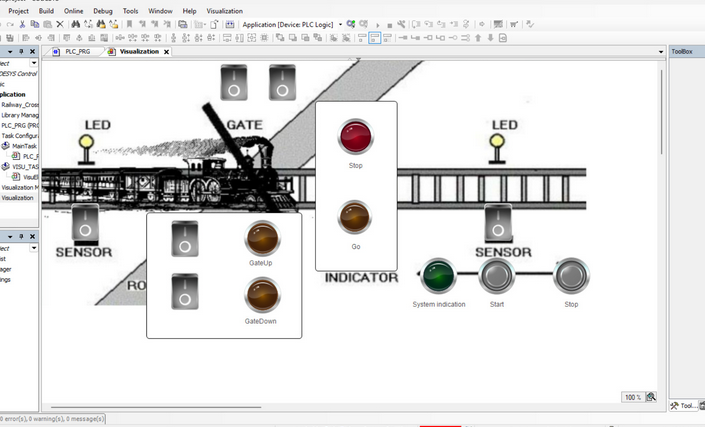
A Human-Machine Interface (HMI) was integrated to provide real-time visibility into the system state - sensor readings, barrier position, crossing status, and any fault conditions - giving operators full situational awareness without requiring manual control.
What Made It Work
The key engineering challenge wasn't just making the barriers move - it was making the system trustworthy. Fail-safe logic was built into every state transition, ensuring that a sensor failure or power interruption defaults to the safest possible state rather than an undefined one. The system was validated across multiple train movement scenarios - single direction, simultaneous approach, and fault conditions - confirming reliable response and safe operation throughout.
What It Demonstrated
This project is a clean example of what industrial automation should look like - a system that operates predictably, monitors itself, and fails safely. The skills it built - PLC programming, HMI design, sensor integration, and safety-critical logic - are directly applicable to real industrial environments.
Industrial Controller Logs
During automated execution cycles, the TIA Portal diagnostics buffer logs sensor inputs and output coil transitions:
[I:0.0] SENSOR_APPROACH_COIL_1 -> Activated (Train Detected)
[Q:0.0] SIREN_SIREN_OUTPUT_1 -> ON (Audio Warnings Active)
[Q:0.1] MOTOR_BARRIER_DESCENT_ON -> ON (Descent limit switch active in 4.2s) (PASS)
By validating the sensor-drive sequences across simulated TIA Portal modules, barrier failures were completely eliminated, establishing a rugged, fail-safe automation loop perfectly suited for demanding industrial environments.
Project Artifacts & Screenshots
Visual interface and simulation environment screenshots from the Automated Railway Crossing control system: