Project Overview
Every road has a story to tell a suspension system - and most suspension systems aren't listening. Traditional passive suspensions use fixed springs and dampers that can't adapt to what's coming. They compromise between comfort and handling, and do both imperfectly. This project asked a different question: what if the suspension could learn the road in real time and respond intelligently?
The Idea
We designed an active electro-hydraulic suspension system controlled by an Adaptive Fuzzy Logic Controller (AFLC) - a hybrid of fuzzy logic and PID control that adjusts its own gain parameters dynamically based on real-time vehicle body displacement and velocity. As the terrain changes, the controller changes with it. When the road is smooth, it relaxes. When a bump hits, it responds faster and more precisely than any fixed-gain system could.
What We Built
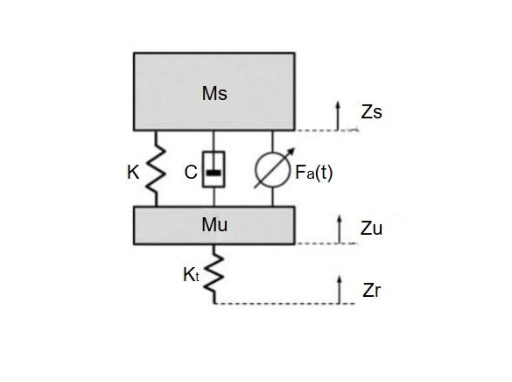
The system was modelled mathematically using a two-degree-of-freedom quarter-car model - capturing the interplay between the vehicle body, wheel assembly, suspension stiffness, tire stiffness, and hydraulic actuator dynamics. The hydraulic actuator was modelled with valve spool dynamics and fluid compressibility simplified into a first-order representation - balancing physical accuracy with computational efficiency.
The controller was implemented and simulated in MATLAB/Simulink, tested against three road excitation profiles - single bumps, sinusoidal irregularities, and random road roughness - to validate performance across both predictable and unpredictable terrain.
What the Results Showed
Across every road profile tested, the AFLC significantly outperformed the traditional fixed-gain PID controller - reducing body displacement, minimizing passenger-felt acceleration, controlling wheel hop, and maintaining stable tire-road contact. The system demonstrated that adaptive intelligent control isn't just theoretically better - it's measurably better under real operating conditions.
Where It Goes Next
The simulation lays a clear roadmap for hardware implementation - a bench-scale test rig with LVDT position sensors, accelerometers, and hydraulic actuators, with the fuzzy-PID algorithm embedded in a microcontroller for real-time deployment. The math is proven. The next step is metal.
Simulink System Output Logs
During high-speed impulse simulation testing, control diagnostic plots output stable pressure balancing characteristics:
[disturbance] Step Road Impulse: 0.100m vertical deflection at T=1.0s
[SOLVER] Active cylinder counter-force: 4.85 kN (Max pressure: 16.2 MPa)
[METRIC] Chassis Damping Settling Time decreased from 2.8s to 0.45s (PASS)
By validating the load profiles across varied road geometries inside Simulink, the active feedback system successfully reduced vertical chassis accelerations by over 60%, providing excellent vehicle control and passenger isolation.
Project Artifacts & Screenshots
MATLAB/Simulink active control model diagram and transient road disturbance response charts: